

Researchers, clinicians, philosophers, and clergy for millennia have studied and tried many methods and ideas about the change process. More to the point, how do people shift into a desired posture or behavior that is a part of their being and not just a form of executing a task? How do we “change” from depression or anxiety, chaos or addiction, to a lifestyle of Christian service and contentment? We all are in a changing process—whether we want to or not. What if we can influence the direction of change we experience? The question then becomes, can we pick our path of transformation?
You are reading this article because there is something inside you that says, “I or my situation can change.” Yes, you and your situation can change – maybe in ways you never thought.
The processes of change listed here are just that – processes. Explanation of change methods gives us a mental framework that organizes ideas into an understandable model, helping us see a path to our desired vision.
There are several forms of thought, or models, that provide the underpinning or foundation of change. For this article, I use Hope Theory, Bowen’s Family Systems Theory, Theories of Humility, and Christian Existential psychology. This article is a very brief introduction. I will expand the ideas in later blogs.
Hope Theory
Hope Theory provides a simple structure upon which to build.[1] Fundamentally, hope requires a vision of the desired state, a plan to accomplish or obtain the vision, and a belief that you have the resources or “agency” to fulfill the vision. Having a vision, developing a plan, and believing you can accomplish the plan require different skill sets. The counseling process helps you in developing each skill set.
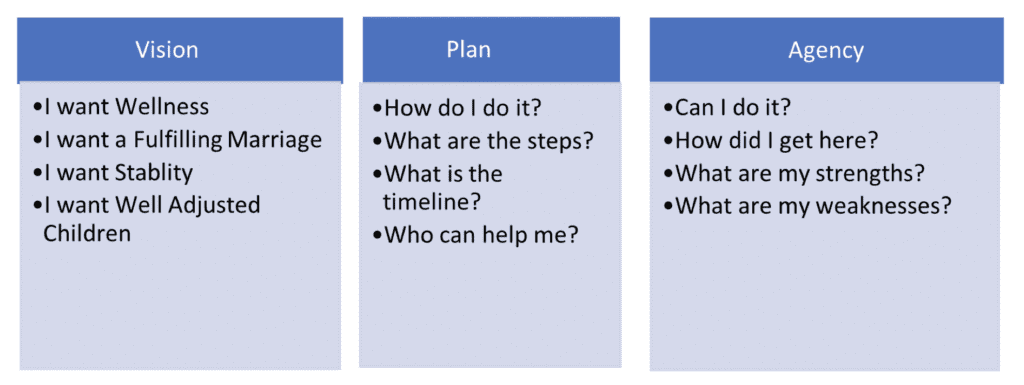
Figure 1. The three parts of hope—vision, plan and agency with some ideas for each.
Bowen’s Family System
Bowen’s Family Systems. Understanding Bowen’s ideas will help fill in the agency box. Through Bowen’s work, you will discover much about yourself—good and bad. I will post another article, expanding the concepts of Bowen’s Theory. Briefly, Bowen proposed we need to withstand the anxiety within ourselves in relation to others. The less we can tolerate our stress in relationships, the more we implement destructive behaviors such as enmeshment or cut-off. He referred to this idea as “differentiation of self.” Being differentiated within a relationship reduces or manages our anxiety levels leading to a better ability to acquire new skills. With the management of anxiety levels, our brains work better at skills acquisition. Another concept Bowen developed was triangling. The popular term is triangulation. People tend to join one group and reject another. To a large extent, our identity modifies to the group’s moral and ethical posture we pick and opposed to the group we do not prefer. Part of the change process identifies what group we genuinely align with, the extent, and how we handle the anxiety of difference within and between groups.
Humility
Humility is a focus of recent research. After much deliberation, researchers were able to summarize broad concepts into three statements that define humility.[2] Humility is “1) a manifested willingness to view oneself accurately, 2) a displayed appreciation of others’ strengths and contributions, and 3) teachability.”[3] understanding that as humans, we don’t know much about most things.
Christian Existential Psychology
Christian existential psychology encompasses much of the above ideas. For many Christians, existential psychology is considered “dangerous.” The troubling issue with existential psychology is that we determine our individual meaning of and for life through humanistic, existential psychology, and not the Word of God. In reality, even as Christians, we all choose who we follow. As stated above about Bowen’s Theory, we all pick a group with which to align. Once the determination has been made to follow Christ, then the work of determining what that means begins. This is a messy process filled with anxiety, uncertainty, challenges, and many rewards. We can take the least resistance route, pick a denomination, learn its creeds, adhere, and achieve group acceptance. We can also expand the path and explore what Christianity (being followers of Christ) means to us as individuals and collectively. The latter seems to encompass a genre of freedom; however, it also accepts responsibility for the exploration. This expanded path narrows the reciprocal relationship between the individual and Christ and the body at large. Freedom and responsibility are core tenants of existentialism as well as Bowen’s Family Systems Theory.
As briefly explained above, the change process can be understood using a few premises. One premise is that we are motivated by having a vision, can imagine a path, and build ourselves mentally, physically, and spiritually to move down that path. Another premise is that we can form agency by exploring humility and differentiation of self founded on a Christian existential framework of freedom and responsibility. This article is a brief introduction. I will expand on these ideas in future articles.
In the next article, I will address the intersection of language and stages of change.
[1] Ezra Stotland, The Psychology of Hope (San Francisco, CA: Jossey-Bass, 1969).
[2] Everett L. Worthington, Don E. Davis, and Joshua N. Hook, eds., Handbook of Humility: Theory, Research, and Applications (New York: Routledge, Taylor & Francis Group, 2017), Kindle.
[3] Hill et al., “A Few Good Measures,” loc. 2889.